Bringing Primary Care Beyond Clinic Walls
Our mission statement has 42 words.
Because I have the attention span of a toddler, my brain stops doing the cognitive work of moving from sign to signified by about word 20. So let me offer you a redacted version. Waco Family Medicine offers “access to high quality comprehensive primary care.”
I know that at some point, a group of individuals thought long and hard about every single one of those 42 words. So much so, that the removal of any single word would either make the mission statement fail syntactically, or more importantly, in its ability to comprehensibly describe what we do.
A recent visit with one of our nurse practitioners has me thinking about just how pivotal each of those words can be. If you follow the Waco news cycle with any regularity you’ve likely heard about Dr. Emily Humphrey.
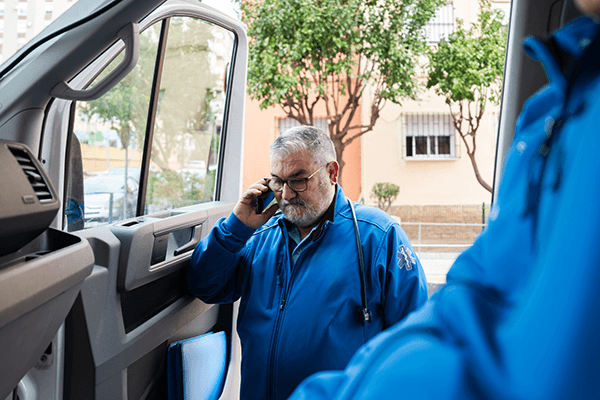
She is the energy and impetus behind Waco Family Medicine’s new street medicine program which you can read about here, here, and here. Dr. Humphrey’s team is redefining the boundaries of access, by taking the primary care experience outside the confines of Waco Family Medicine’s thirteen clinics and into the streets of Waco to serve individuals who are experiencing homelessness. For 20 hours every week Dr. Humphrey and her team restock their street medicine van, load their medical backpacks, and go looking for some of Waco’s most vulnerable residents.
The idea isn’t new. There are roughly 150 street medicine programs across the United States, but no one was doing it in central Texas. That started to change 2 years ago when the Humphrey family made the move to Waco. Dr. Humphrey started her journey in medicine as an undergraduate student at Baylor where she majored in medical humanities. Soon after her and her husband moved to Nashville when she was given the opportunity to earn her MSN-FNP from Vanderbilt and followed that up with a Doctor of Nursing Practice from the University of Tennessee’s Health Science Center. But perhaps more impressive than her academic record is her work experience. In Nashville Dr. Humphrey began working at a homeless healthcare clinic at a local FQHC in addition to an inpatient addiction facility. After relocating to Texas, she again found herself doing both outpatient addiction care and healthcare for the homeless with CommUnityCare Health Centers, Austin’s flagship FQHC.
As you listen to Dr. Humphrey share her story you feel like you are talking to someone who won the lottery. Her excitement for her work is palpable, so much so that it makes discerning the lines between vocational choices and what feels like fate difficult. No matter where she’s ended up she’s found a way to bring high quality primary care to the margins of society. So, when her family decided to move to Waco two years ago she left behind not just a job, but a passion.
Persistence
The move to Waco brought Dr. Humphrey a new challenge. There was no establishment offering the kind of primary care experience that she’d been able to do in both Nashville and Austin. So, what did she do? She called Waco Family Medicine to begin knocking on doors. She was hired as a floating Nurse Practitioner which she did by day, but she moonlighted as a ferocious researcher of street medicine programs. She described to me one particularly salient experience when she traveled to the International Street Medicine Symposium in September of 2024. There she tells me she spotted a guy with a street medicine shirt in the airport. She struck up a conversation which evolved into a shared ride to the symposium. Her companions turned out to be Brett Feldman, vice chair of the Street Medicine institute and the spouse of Jaynell “KK” Assmann, the founder and CEO of Care Beyond the Boulevard, Kansas City’s own ingenious medical for the marginalized program. The encounter is a good example of the kind of serendipity earned through persistence that Dr. Humphrey seems to move in. That car ride turned into friendships that forged new possibilities. And it was just the first of many that weekend. Dr. Humphrey returned to Waco with a clear focus and a mandate. Central Texas would get its own street medicine program.
Almost everyone she talked to within Waco Family Medicine shared her enthusiasm for the program, but she kept running into the same problem, funding. Then one day she spotted a possibility. The Health Resources and Services Administration was giving out grants to medical residency programs looking to offer street medicine training to residents. Dr. Humphrey got into contact with Dr. Ryan Laschober who also had his eye on the same grant and whom Dr. Humphrey is quick to give credit to for putting the grant together. When award letters were issued, Waco Family Medicine’s Institute learned that they were one of twenty-four applicants out of one hundred to be awarded a grant and they were given the maximum award of $2.5 million. Dr. Humphrey’s passion now had a financier and Dr. Laschober now had a way to expand street medicine knowledge within the residency. It’s the kind of institutional synergy that has enabled Waco Family Medicine to innovate since its inception.
And it Makes Cents
Dr. Humphrey’s enthusiasm is infectious, so after frantically scribbling notes for 45 minutes I asked her the question that I wanted to know most, namely, what drives her passion for street medicine? Her answer came in layers, moving from the pragmatic to the profound. For starters, street medicine is an economic win for everyone. “Data collection!” she began, “It’s interesting to see the impact you can make on a system. Sometimes it can be so overwhelming to look at a systemic problem and not know what to do, but this really makes a difference.” I’ve heard our CEO Dr. Griggs articulate that for every $1 primary care can save taxpayers between $6-$13 dollars downstream. Dr. Humphrey’s program might be a quintessential example of that kind of efficiency. Data shows that Brett Feldman’s street medicine program saved Leigh Valley Health Network $3.7 million in ER costs in the first year of implementation. One wonders if HRSA is betting on those same kinds of savings with its grant investments. While it’s too early to tell what kind of impact this will have on Central Texas, Dr. Humphrey already has anecdotal data, “We saw one guy with chemical burns on his legs. He was going to wait and see if they would improve on their own, but it was obvious the wounds weren’t going to heal. With the street medicine program we have been able to dress his wounds three times a week. That will keep him out of an ER and enable him not to miss his GED classes.”
But it’s not just the economics of street medicine, it’s also the moral education. Dr. Humphrey lights up as she shares stories of the communal generosity that exists among those experiencing homelessness. “They take care of each other. They share what they have. One guy offered to buy his friend lunch. And one day they invited us to have lunch with them, and part of doing this work well means that we accepted.” In short, the street medicine team isn’t just treating patients, they are offering dignity and receiving it in return. The work is filled with encounters that humanize everyone involved and remind the rest of us that what differentiates us is circumstance, not civility.
But neither economics nor moral education get to the core of Dr. Humphrey’s passion comes from her faith convictions. “I feel closest to the Lord when I’m taking care of the least of these. Imagine encountering someone on the worst day of their life and being able to offer them medicine. People are so hopeless out there. So used to being let down. We build credibility, and sometimes it can take years, but it’s worth it.”
Some of us work our jobs because we have to. Some of us love what we do. But occasionally you encounter someone who does their work because they were made for it. Frederick Beuchner called that vocation, “the place where our deep gladness meets the world’s deep need.” And that? That’s contagious.